Stop the Tool Toggle: How Marketing Agencies Reduce Context Switching and Boost Client ROI
Marketing agencies lose hours every week jumping between Slack, email, and project tools. Learn how to reduce context switching, improve response times, and boost client ROI with a unified communication hub powered by AI.

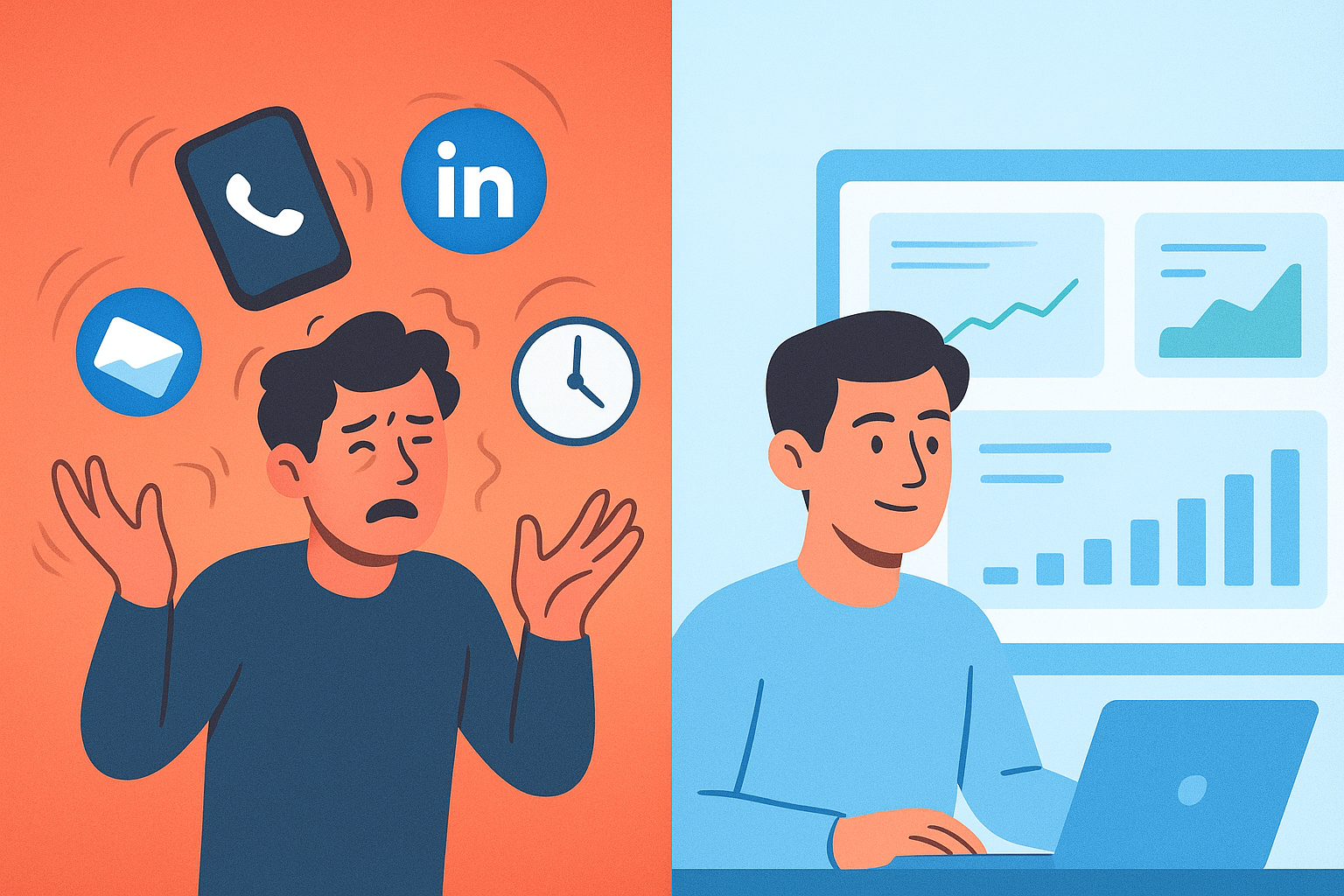
We know the scene all too well. It’s 9:00 AM on Monday, and your browser looks like a crime scene.
You have twenty-three tabs open:
• Client A's Trello board.
• Client B's performance report in Google Analytics.
• Client C’s creative brief in a shared Google Doc.
• Four different Slack workspaces demanding your immediate attention.
And that’s before you even dare to open the email inbox that holds 150 unread messages, a mix of internal check-ins, urgent client feedback, and spam.
Does this feel familiar? If you manage a growing agency, the chaotic reality of juggling dozens of clients - each with their own preferred communication channel, reporting dashboard, and unique set of tools - is the silent killer of profit.
This constant, frantic shifting of focus is called context switching. It’s the energy-draining, time-sinking habit that prevents your brilliant team from doing the deep, focused work they were hired for.
To truly scale your operation, you must implement a strategy where your marketing agency reduce context switching as a core operational principle.
We’re not just talking about minor productivity gains; we're talking about a fundamental operational shift that directly impacts your bottom line and, most importantly, your clients’ Return on Investment (ROI).
You need to stop the tool toggle. It’s time to move past the chaos and unlock a new level of efficiency.
The Hidden Tax: Why Context Switching Decimates Agency Profitability
As agency leaders, we obsess over utilization rates and billable hours. But have you ever truly calculated the cost of that mental whiplash your team experiences every hour?
Psychological research is clear: when you rapidly switch between unrelated tasks, your brain doesn't just instantly "reboot."
You suffer from an effect called "switch cost."
What is Your Agency's "Switch Cost"?
The switch cost is the time and energy you waste simply getting back into the flow of work after an interruption. It's the mental friction of remembering:
• Where you left off on Client D’s complex SEO audit.
• The specific brand voice you need for Client E’s social media reply.
• The internal status of the creative asset you were reviewing for Client F.
Are you seeing the problem?
This lost time isn't just a few minutes; it aggregates into hours of lost productivity every single week, directly eroding your margins.
We let this chaos persist because we believe it’s the price of a personalized, responsive service. We assume we must be in all places at all times. But this reactive work style is actually slowing down client results.
Want to see a simple way to manage your communication more effectively? Check out our article: The Ultimate Guide for Managing Emails and Slack without Losing Your Mind. It starts with recognizing the enemy: the uncontrolled influx of notifications.
Strategic Tool Consolidation: The Key to Scaling Client Services
How can you possibly scale your client roster from ten to thirty without hiring three new project managers? The answer isn't in adding people; it’s in removing unnecessary cognitive load from your existing, high-value talent.
To successfully reduce context switching marketing agency teams must first centralize their core communications and tasks.
The Power of the Single Pane of Glass
Imagine a world where your account manager only needs to look at one screen to understand the status of every single client request.
No more hunting through:
• Client emails for a forgotten image file.
• Internal Slack for a quick question about budget.
• Asana for the due date on a specific task.
This unified view - the single pane of glass - is not a futuristic dream; it is the essential requirement for operational efficiency in the modern agency.
By streamlining tools, you:
1. Accelerate Response Times: You can address client requests faster because the information is immediately accessible.
2. Reduce Cost of Service: Less wasted time means higher utilization and a better margin on every billable hour.
3. Improve Work Quality: Focused work is better work. Your team delivers higher-quality campaigns when their minds aren't fragmented.
We must actively fight the urge to adopt every new shiny app. Instead, embrace an integrated platform that connects the dots for you.
How Deemerge.ai Enables a Marketing Agency to Reduce Context Switching and Boost ROI
The challenge with most project management tools is they still require manual entry or constant vigilance across multiple platforms. Deemerge.ai changes the game by automating the very process that creates the context switching problem.
1. AI-Driven Communication Triage
Your team doesn't need to manually read and categorize every inbound message from every client channel.
Deemerge.ai's AI engine can:
• Identify Urgency: Automatically flagging messages that require a four-hour response versus a four-day response.
• Categorize Requests: Assigning incoming messages (from email, Slack, Teams, etc.) directly to the relevant client, campaign, and team member.
• Extract Key Data: Pulling out a new budget number, a creative file, or a specific performance metric and storing it in a centralized location.
This means your team starts the day with an intelligent, prioritized task list, not a messy inbox. This is a crucial step to reduce context switching marketing agency efforts.
2. Centralized Client Activity Hub
Stop forcing your employees to open five different apps to understand a client's status.
Deemerge.ai serves as your central hub, pulling in critical data feeds:
• Campaign Performance: Integrates with Google Ads, Facebook, and other ad platforms to show current ROI data.
• Task Status: Connects with Asana/Trello/Jira to display the completion status of deliverables.
• Communication History: Shows all client-facing dialogue in one thread, regardless of the original channel (email, Slack, etc.).
With all this information consolidated, your account managers can prepare for a client call in under five minutes, drastically cutting down on prep time and eliminating the need to toggle between apps.
Think about the immediate value this offers your clients: faster, more informed responses mean greater trust and a more confident partnership.
The Financial Impact: Measuring ROI Gains from Reduced Switch Cost
We've established that context switching is a "silent killer of profit". Now, let's quantify that loss and understand the immense financial upside of solving the problem.
Every time your team toggles tools, you lose billable time. You pay highly skilled strategists to search for client files or categorize an email, not to execute high-impact work.
Calculating the True Cost of Distraction
Consider a simple, but eye-opening calculation.
If a team of five senior strategists switches contexts just 20 times a day, losing five minutes each time, that equals:
• 100 lost minutes per person per day.
• 500 lost minutes, or 8.3 hours, for the team daily.
• Over 40 lost hours per week - full-time employee's worth of waste!
By implementing a tool like Deemerge.ai, you reclaim those hours. You instantly increase the effective utilization rate of your existing talent pool without any additional salary expense.
This is how you scale your client roster from ten to thirty without hiring three new project managers. The efficiency gain immediately translates to higher profit margins on every single client account.
Case Study: The Client Response Time Revolution
Client satisfaction often hinges on two things: results and speed of communication. When a client has a question, they expect an informed answer quickly.
Before implementing a centralized hub, your typical client request cycle might look like this:
1. Client sends an urgent budget question via email.
2. Account Manager (AM) sees the email, but is busy reviewing social creatives (Task 1).
3. AM switches to Google Ads to check the budget spend (Task 2).
4. AM switches to Slack to ask the Media Buyer if there are any planned budget shifts (Task 3).
5. AM switches to Asana to see when the last budget report was filed (Task 4).
6. Four apps and 20 minutes later, the AM finally drafts the response.
This slow, fragmented process creates unnecessary anxiety for the client and consumes nearly half an hour of your agency’s time.
Speed and Confidence: After Centralization
With Deemerge.ai's centralized client activity hub, the scenario changes dramatically.
• The system ingests the client email and immediately pulls the current budget spend via its Google Ads integration.
• The information is displayed on the client's single activity thread.
• The AM sees the notification, opens Deemerge.ai, and instantly sees the question, the current spend, and the Media Buyer's last note - all in one place.
The AM now answers the client's question in under five minutes with complete, accurate data. This isn't just about saving 15 minutes; it’s about providing faster, more informed responses that build greater trust.
Greater speed means you can service more clients with the same high-touch quality.
The Human-Centric Agency: Scaling Without Burning Out Your Talent
High employee turnover is another hidden financial drain on your agency. Constant mental whiplash is not only inefficient; it is exhausting.
When you continuously demand your team toggle between client A's voice, client B's budget, and client C's creative needs, you are actively contributing to burnout.
Retaining Your High-Value Talent
Your best strategists crave deep, focused work, not endless administrative tool-toggling.
By using a tool that automates the tedious, low-value work like tracking down a file or categorizing an email - you send a powerful message:
• We value your strategic thinking.
• We protect your focus time.
• We will remove obstacles to your productivity.
A focused, less-stressed team is a high-performing team. Retaining your top talent because you’ve created a more focused work environment is a massive ROI win for your agency.
This is the true secret to scaling: scaling focus, not just headcount.
From Reactive to Proactive: Shifting the Agency Mindset
The daily chaos of context switching forces your team into a reactive firefighting mode. You're constantly chasing immediate requests, which leaves no room for proactive, strategic thinking.
How can you truly deliver innovative strategies when your team spends all day simply managing communications?
Prioritized, Intelligent Task Management
Deemerge.ai's AI-driven communication triage immediately solves this problem.
Instead of manually sifting through 150 unread messages, the system delivers a perfectly sorted, prioritized list:
• A red flag for the critical budget change request (Urgency identified).
• A blue flag for the routine monthly report request (Categorization complete).
• All non-urgent internal check-ins are bundled and deferred.
This allows your strategists to dedicate their mornings to deep, proactive work like the campaign planning, the audience research, and the testing that truly moves the needle for clients.
When you stop reacting, you start strategizing. That fundamental shift is the core value proposition you should be offering your clients.
To successfully reduce context switching marketing agency teams must be empowered to ignore the noise and focus on the signals.
A Three-Step Framework to Eliminate Tool Chaos
The idea of overhauling your entire operating system can feel daunting, but you can approach marketing tech stack optimization systematically.
We need to implement a clear, phased strategy to move your agency from chaotic communication to centralized clarity.
Step 1: Audit and Isolate the Switch Costs
Before you adopt any new platform, you must first identify your agency’s biggest bottlenecks.
• Where does the most wasted time occur? Is it reporting, client approvals, or internal status checks?
• Which five tools cause the most frequent toggling for your account managers?
• Where is client information most fragmented? (e.g., Client A uses Teams, Client B uses email, Client C uses Slack).
Identifying these switch costs allows you to tailor your solution to your agency’s specific pain points.
Step 2: Centralize and Automate the Inputs
This is where an integrated tool like Deemerge.ai becomes indispensable.
• You must choose a tool that integrates all the disparate client communication channels -email, Slack, and even project management tools.
• The system must automatically triage and categorize the requests without human intervention.
• The goal is to stop the manual entry that requires constant vigilance across multiple platforms.
By centralizing the inputs, you create the "single pane of glass" that is the essential requirement for operational efficiency.
Step 3: Train for Deep Work
Centralization is a tool; deep work is a habit.
Once the communication chaos is contained, you must actively train your team to utilize their reclaimed focus time:
• Schedule "focus blocks" where non-critical internal chat is minimized.
• Encourage the use of the prioritized task list delivered by Deemerge.ai.
• Celebrate proactive wins (e.g., "We launched that new campaign because we weren't stuck in email all morning").
The goal is to shift your agency's culture from frantic reaction to deliberate, strategic execution.
Integrating the Ecosystem: How Deemerge.ai Plays Well With Others
We know the fear: adopting a new "all-in-one" solution often means ripping out all the specialized tools your team loves and depends on.
But true efficiency comes from integration, not isolation. The best platforms act as a central intelligence layer, not a replacement for everything.
The Intelligence Layer for Your Current Stack
Deemerge.ai doesn't ask you to abandon Google Analytics, Google Ads, or your current CRM. Instead, it connects to them.
• It pulls live campaign performance data from your ad platforms directly into the client activity hub.
• It monitors the completion status of deliverables in your existing project management tools like Asana, Trello, or Jira.
• It takes the key data - the budget, the creative file, the performance metric—and extracts it into a centralized location.
This ability to harmonize your existing tech stack ensures a smooth transition and maximizes the value of your previous technology investments.
We want to eliminate the tool toggle, not the tools themselves. We're removing the friction between them.
The Future of the Agency: Efficiency is the New Creative Edge
In a competitive market, every agency boasts about their creativity and strategy. But the truth is, the most successful agencies are the ones that can execute that strategy with speed and precision.
Your ability to reduce context switching marketing agency efforts directly dictates your competitive advantage.
Final Thoughts: Winning Back Your Margin
Stop letting the small, daily chaos of notification noise steal your margin and burn out your team.
Embrace a centralized, intelligent operational structure that frees up your greatest resource: the focused minds of your strategists.
When you reduce friction, you accelerate results. When you accelerate results, you boost client ROI. That is the non-negotiable path to scaling your agency's success.
Stop letting context switching drain your profits and delay your clients' success. It is time to implement a centralized solution that puts your team's focus back on high-value strategy.
See How Deemerge.ai Boosts Client ROI Today!